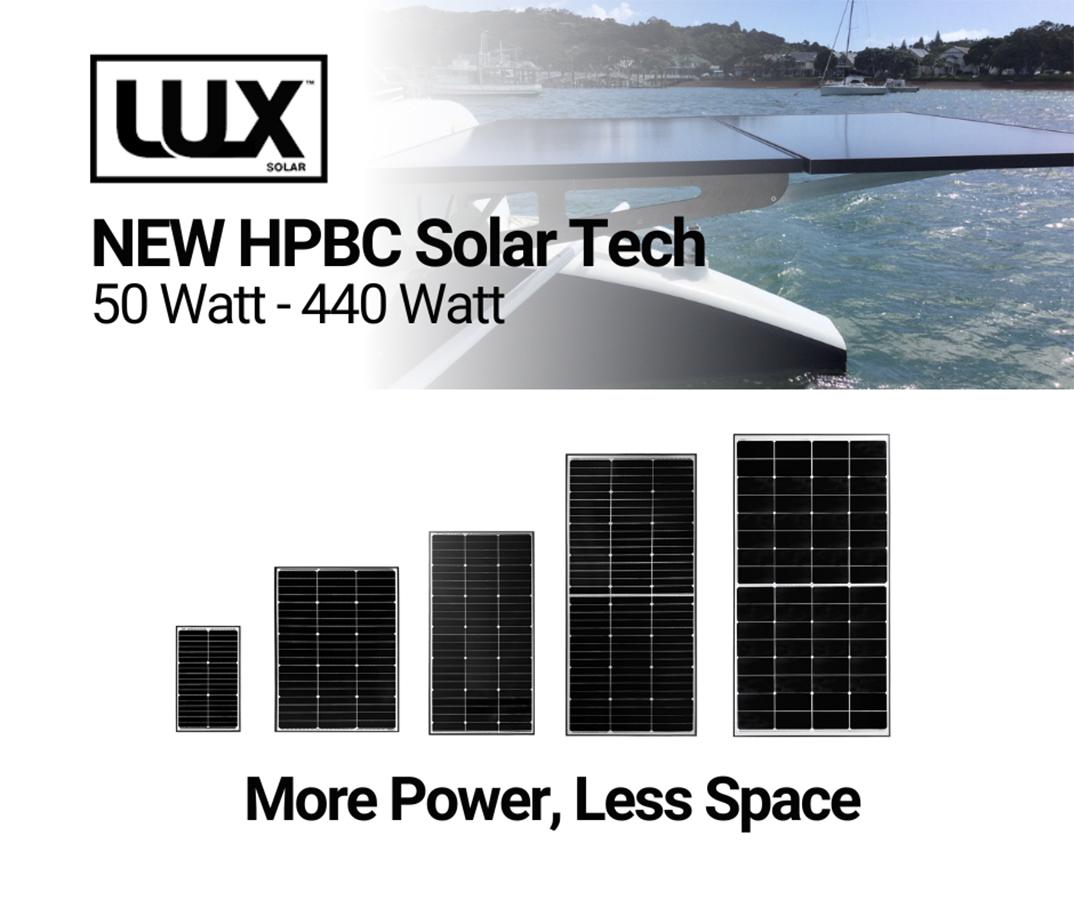
Selecting Solar Panels for Your Marine or RV Solar System
Introduction
This knowledge article provides guidance on choosing solar panels and calculating required solar input for marine and RV applications.
Solar Panel Types
Solar panels fall into two main categories:
-
Fixed panels - Produced for many years with aluminum frames and long-term durability, ideal for houses, solar power plants, and large fixed structures
-
Flexible solar panels - Relatively new technology becoming robust with materials like ETFE. Look for panels with suitable IP ratings to ensure longevity
Selecting Your Panel Type
For Fixed Installations (Houses):
- Use fixed panels with junction box rated IP65 minimum
- Choose IP67 connectors
- Prefer monocrystalline over polycrystalline types
- Monocrystalline offers better efficiency despite higher cost due to uniform crystal structure and greater power output per area
For Automotive/Marine Applications:
- Flexible panels may be more suitable due to versatility, lightweight design, and portability
- For marine environments, ensure minimum IP67 rating
- Salt water's corrosive nature makes water protection critical for panels, junction boxes, cables, and MC4 connectors
- LUX Solar certifies all panels and components to IP67 standards
Sizing Your Panel
Before selection, determine your power requirements by reviewing daily power needs documentation.
Simplified Calculation Method: Use this basic formula: Panel size = Total power consumption per day / 4 hours
Example: A 100-watt daily consumption device requires approximately a 25W solar panel (100 W/h / 4 hours).
LUX Solar has developed software that tracks sun position daily throughout the year, accounting for efficiency, orientation, latitude, irradiance, sunshine hours, and shade conditions.
Recommendation
Simply use our Lux solar calculator to determine which one of our pre-designed kits will suit your needs. All gear is designed specifically for marine applications.
Contact
For questions or feedback: info@luxsolar.co.nz